Cookies Consent

Wednesday, June 27, 2018

Traveling to Salzburg, Austria

Salzburg -  Do you enjoy Mozart?   Do you like "The Sound of Music" movie?      
When Jack and I got engaged at the University of Marburg, Jack's parents came over and took us on a trip, including Salzburg.  That was 47 years ago.  So Jack and I had a blast spending 4 days learning much more about Salzburg.  


The Hohensalzburg Fortress overlooks the town and has a fascinating history.


In the cathedral is the baptismal basin in which Amadeus Mozart was baptized!!


I thought it was exaggerated when folk got excited about Salzburg being the town of "Sound of Music".  But when we visited this quaint cemetary, I did get excited to be on the spot where the fleeing family meets Rolf in this cemetary and he decides to whistle!


This is the outside stairs at the music festival building where the Trapp family secretly ran away.  The music festival is still a huge event in this city.


The Salzach river plays an important role in the history of Salzburg.  It's one of the only cities that never experienced the plague and that's because the streets were flushed on a regular basis.


Untersberg is a short bus ride away and the highest funicular (6080 ft) we've ever traveled.  Fun!


The views were quite different on the various sides. Here we saw the Alps in the distance.


  We spent a couple of hours hiking and climbing. Oh Europe - no railing!  at least not everywhere.


The grass is very fragile and one is asked to stay on the trails, but some times the gravel is awfully slippery.


Another hill conquered!


Great museums - here in the folklore museum Jack stands beside a 200 year old Fastnacht (Mardi Gras) parade character.


A music room at Hellbronn Castle!


The Salzburg Museum is one of the very best laid out and curated museum we've ever visited.  We spent 6 straight hours there and it felt like less than 3 hours!


This old wood carved and inlaid room was brought intact from a tavern in the area.


Ancient musical instruments in the museum and performed on screen.  Amazing!


These paintings, by artists who were deemed degenerate by the Nazis, have been found hidden in basements and attics.  The Jewish artists did not survive.


We continue to be fascinated by the restoration that is involved in all these European museums.  In many places we've had access to observing workers in action.


In Salzburg they serve a variety of big pretzels, each yummy in its own way.


The fortress is enormous and here is a view from an inside court.


Another view looking down from the fortress.


You know it's a fancy meal when the dessert looks like this.  Ever so tasty!


This dinner at the fortress was followed by a lovely concert, with views of dusk over Salzburg.


Yes, we toured Mozart's birth house and residence.  What a genius he was and what a loss that he died so young!


Another monastery with a brewery - each one nowadays has a different kind of restaurant.  In this one the wait staff only bring beer refills.  You go to different windows for different foods, like at a food bazaar.  But then everyone sits at long tables together.


Mirabell Castle with beautiful gardens - see fortress in the distance


and a floor, which shows a map of Salzburg  -  crouching right on Mirabell Castle.

Monday, June 25, 2018

Traveling to Bad Dürkheim

As a German teacher I'd always look at the picture of the Bad Dürkheim Riesenfass and wish I could have seen it.  Well, now Jack and I have visited the town and eaten in this gigantic actual wine barrel!


It was built in 1934 to be the biggest in the world.  It held 1.7 million liters wine and was used for 20 years, then sold to become a restaurant.  Of course we had to get their wine sampler tray.  It was fun!


Of course we did all that after we hiked to the Hardenburg castle ruins (built 1205!).


We spent two hours exploring the different levels and listening to an audioguide with fascinating details.

We spied the Benedictine Cloister Limburg across a valley on another hill.  The travel brochures made it sound like a quick hike.  Well, it wasn't.


Jack snapped this of me after the last push up a very steep part and when I didn't realize the cloister was right beside me!  We had to really hurry up and then back down this steep hill because the bus at the bottom only came a few times on that Saturday.


It was older (1027) and much smaller than Hardenburg, but still interesting.  


And we made the bus back to the city of Bad Dürkheim, where we enjoyed a good meal in the Riesenfaß restaurant and sampled the wines of the area.  


If a German city has Bad in its name it signifies a spa.  Here there is a "saline" built in 1847 to produce salt, but was later used for it's health benefits - walking around it is just like walking along the ocean; you breathe in salty air.  And the spas around use the salt in their baths.  

It burned down in 2007 and was rebuilt for a cost of 5.5 million Euros, plus 1 million for the solar power plant!  The brine is pumped to the top and drips down through the brushwood; water evaporates and salt is concentrated.   A gorgeous park runs from here through the city.  Delightful!

Traveling nearby - Speyer and Sandhofen KZ

Today we participated in a tour of Jewish life and history in Speyer, near LU.


The tour started at the Dom (Catholic Cathedral) because originally the Jewish people were invited to the city by the Archbishop.  They were the money handlers of the day.


The Mikwe, ritual bath, from the Middle Ages now has modern stairs down to the flowing water.  At that time the street level was that low.


It seems almost every German city has a Judengasse, a Jewish alley.  Here it intersects with the Pfaffengasse, the preachers' alley.


Our young Jewish guide stopped at many stores and told/showed us which Jewish family owned it before it was confiscated by the Nazis, and what kind of a business they had.  We learned that in WWI the young Jewish men fought bravely and got many medals including the Iron Cross, but none were ever allowed to become officers.


At the end of the tour she showed us pictures of the burning of the synagogue on Nov. 9, 1938 - the Night of  Broken Glass, or as Germans call it "Kristallnacht".


We got a tour of the new synagogue and a description of how their worship services are run.  This is a rather conservative synagogue, with most members coming in the last years from Russia.  They don't have their own rabbi.  The women sit separated by a curtain and our guide said most of the time they visit with each other and don't pay attention.  Different!

Jack and I had to run to catch our train to Mannheim, across the river from LU.  Here we found our way to this school in the suburb of Sandhofen
:

It's a cheerful place with groupings of huge pencils every few yards of fence around it.  But in the basement is a small but thorough museum of the Außenlager KZ (outlying concentration camp) that was in this building from 9/27/44 until end of the war in May 1945.


Every few months the historical archivist gives a tour.  It was 2 hours long and we learned a lot.


This is a picture of the building before 1913.  So you can see that even though it was large, the men were cramped in the rooms which just held bunkbeds.  There were over 1000 and most of them came from Poland.

In fact, the head of Daimler Benz asked the SS for new inmates who were strong enough to work in their factory, where they were producing trucks for the war effort.  He was told to report to the Dachau KZ (concentration camp) near Munich and select his own 1060 workers.  He and an assistant did this and chose a group that had recently come from Poland.  So unlike most KZs where the Nazis tried to mix types of people, different countries, languages and so on, in this one men knew each other from back home.  The SS soon imported the worst guards because the men were too friendly towards each other.

The men were given the same food as soldiers, but because the SS sold so much of it to the local population, the prisoners hardly got anything.  In spite of this they had to run every morning from the school building to the Mercedes plant.  After a 12 hour shift they ran home.


Our tour guide said that people often assume that because it was the last year of the war, it couldn't have been too bad for the prisoners.  Far from true!
Daimler Benz became uncomfortable that when the war ended they would be accountable for these sickly workers.  So they asked the SS to send them away - since they also weren't productive any more.
Some were put on trains to Dachau KZ, but others joined other KZ prisoners in a death march to Buchenwald.

13 million people became forced laborers in Germany.  In Mannheim alone they counted 142 businesses that used these prisoners, but now with more research he told us, they think it was up to 300.

There were many of these smaller concentration camps that organizationally belonged to a larger one.  No one had identified Sandhofen as one until a history teacher (Peter Koppenhöfer) in this school discovered this history.  He found a Polish forced labor prisoner who had stayed in the area working for the U.S. army after the war.  This amazing teacher began researching and interviewing.  He even learned Polish so that he could get their stories down on paper.

The youngest were four 14 year olds.


Sunday, June 24, 2018

Traveling to Neuwied

We were invited by an previous co-worker of my father to visit the old city of Neuwied and Eirene (a multifaith, pacifist organization that sends mostly young persons to volunteer for a year in another country), and learn about the Mennonites who have settled here.

This building is now an city art museum, but in 1768 the Mennonites started worshiping here.  In 1653 the Graf von Wied invited Mennonites, Jews, and Protestants to come to this Catholic town.  He had them build their churches and synagogue  in close proximity to his castle for his protection.  This summer there will be an exhibit here to celebrate the 250 years Mennonites used this building.  


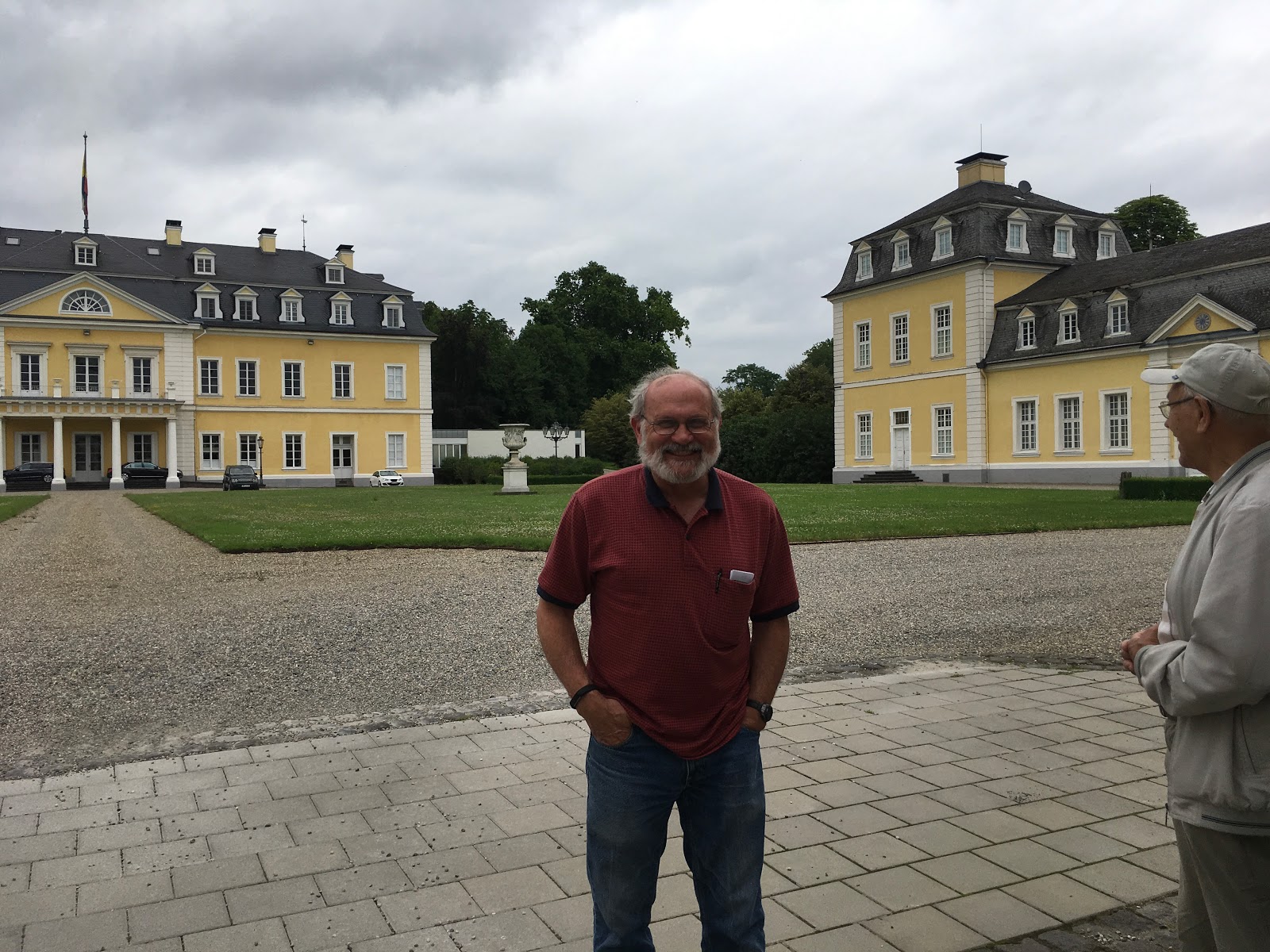
Btw a Graf still lives in the castle across the street!  The castle is a private residence and can't be toured.  We just stepped into the gate!  

Nowadays there are four or five Mennonite congregations, two Mennonite Brethren and two Mennonite.  Each functions fairly autonomously and there is little interaction.  


At Eirene we talked with the friendly employees and learned a bit more about their work.  Mostly stories about my father were told.


The city of Neuwied wants to put such plaques in many parts of the city.  Do you recognize the symbols of the main religions, which form the angel?


We spent the night in a Mennonite home and appreciated visiting with this lovely family.  Ask us about their story.


An added bonus was that we got to tutor at an Asyl Cafe and I met Surji from Somalia, while Jack worked at beginner German with a woman from Afghanistan.